Research Overview and Past Projects
Context and Motivation
Thin particles structures refer to systems (material structures, particles, crack-like voids) where one characteristic length is much smaller than the other(s). Such structure typically arises in electromagnetism (strong field enhancement by thin nanoparticles, in photonic crystals made of periodic assembling of nano-rods, or metasurfaces with disordered dielectric rods).
It is fundamental to understand how the near-field is affected by a thin particle, as well as understanding how the coupling effects caused by several ones (number and sizes) contribute to field enhancement.
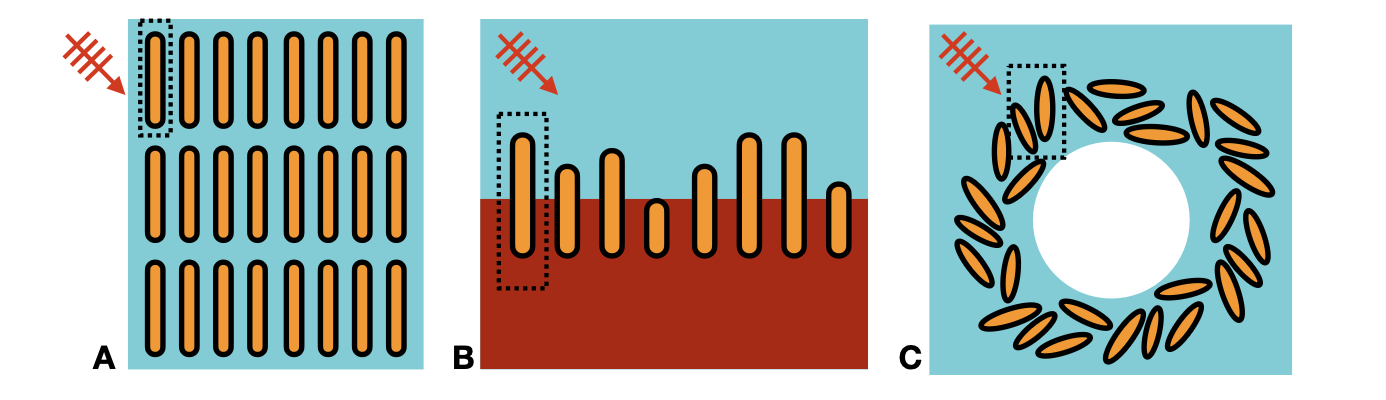
Methodological Framework: Boundary Integral Equations (BIE)
Due to inherently high anisotropy and localized field interactions, it is particularly appealing to use boundary integral equations. BIE methods offer several advantages:
- Dimension reduction of the problem to the boundary, significantly reducing computational costs.
- High accuracy to compute boundary data, allowing evaluation of the field anywhere in the domain without restriction to a particular mesh.
BIE methods provide valuable physical insight over all scales of the problem, and they generalize easily to more complex problems including multiply connected domains, e.g. ensembles of thin particles.
Scientific Challenge: The Close Evaluation Problem
One of the main challenges in BIE methods is the so-called close evaluation problem: layer potentials become nearly-singular integrals and large errors occur when computing them.
The close evaluation problem in thin particles structures is twofold:
- It becomes difficult to evaluate near-field close to thin structures.
- It is enhanced at the BIE level due to boundaries close to each other (between two particles or from each side of the particle).
Thesis Objective
This thesis, supervised by Camille Carvalho and Elie Bretin within the Mathematical Modeling and Scientific Computing team at Camille Jordan Institute (ICJ), aims at developing efficient quadrature methods for boundary integral equations that address the close evaluation problem, and allow to efficiently characterize the near-field within multiple scattering by thin particles structures.
Funding
My doctoral contract is funded by a Contrat Doctoral Spécifique Normalien (CDSN), which I was awarded during the 2026 campaign. Other costs of the thesis are covered by the ICJ and Camille Carvalho's ANR JCJC BISCOTTI project.
Past Research Internships and Projects
Master 2 Internship: A boundary integral equation approach to photonic crystal band structures
Supervisor: Camille Carvalho
Exploring boundary integral equations (BIEs) to model band diagram and simulate Moiré patterns in collaboration with the INL i-lum team (Lydie Ferrier and Marion Lavignac).
Master 1 Internship: Shape optimization and the adjoint method for Poisson problem
Supervisor: Cristian Barbarosie
Worked on shape optimization, parallel computing on clusters using maniFEM, and code contributions.
Bachelor Internship (L3): Game theory and traffic flow
Supervisor: Filippo Santambrogio
Study of Wardrop equilibria and the price of anarchy in road traffic.
Bachelor Theses (L3)
- Julia Curves without Tangents (Supervised by Charles Francès).
- Scientific Computing: Finite-difference blood flow modeling (With Ewan Contentin, supervised by Clémentine Courtès).